When the Tonle Sap Flows Uphill: A Respectful Guide to Cambodia’s Moving Lake
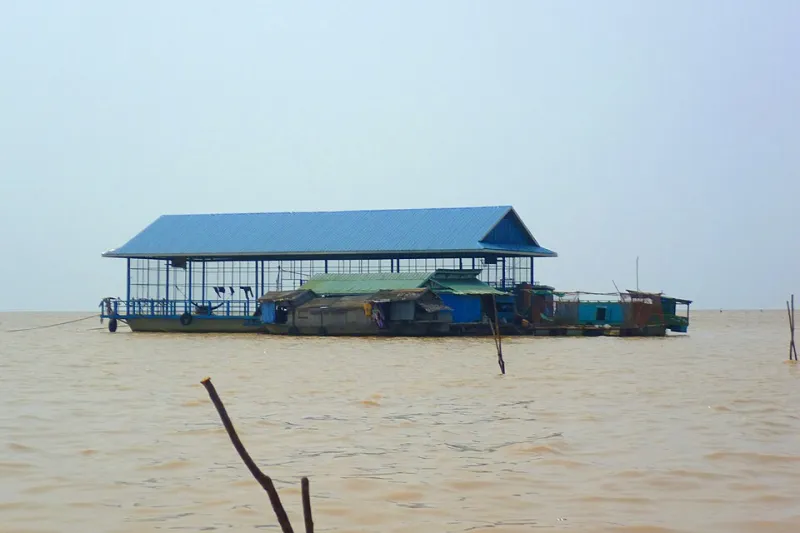
Photo: RoadTripWarrior, CC BY-SA 3.0, via Wikimedia Commons
Most travelers meet Tonle Sap as a half-day add-on from Siem Reap: a bus, a boat, a sunset, a souvenir stall. That version is easy to book and easy to forget. The lake itself is stranger and more interesting. It is Southeast Asia’s largest freshwater lake, and for part of the year it does something that sounds like a mistake in a geography textbook: it flows backward.
The plumbing behind the postcard
During the dry season, Tonle Sap drains southeast into the Mekong River near Phnom Penh. Then the southwest monsoon arrives. The Mekong swells, its tributaries back up, and water pushes northwest into the lake instead. The lake can expand to several times its dry-season size, drowning forests and fields and turning roads into waterways. When the monsoon eases, the current flips again and the lake exhales. This is the flood pulse, and it is the engine behind one of the richest freshwater fisheries in the world.
You do not need a hydrology degree to see the result. You need a boat, patience, and a willingness to notice what the water is doing to the land.
What moves with the water
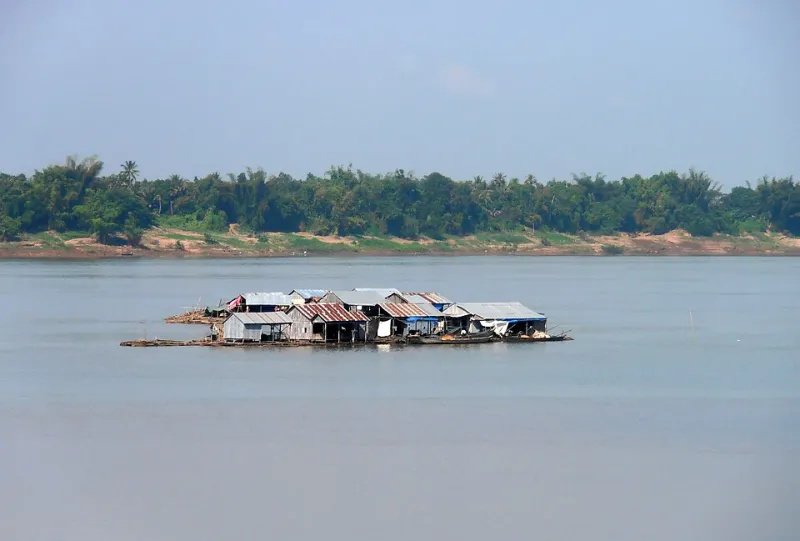
The villages around Tonle Sap are often lumped together as floating villages, but they are not all the same. Some communities live on stilted houses that rise above the flood line. Others sit on rafts that are towed as the water shifts. Schools, shops, and markets may float, or they may migrate. In places like Kampong Phluk and Kompong Khleang, the stilted architecture is the story: tall wooden legs, ladders, and the knowledge that the ground floor will be water for months. Around Prek Toal, the flooded forest becomes a breeding ground for waterbirds and a nursery for fish.
The flooded forest is the part most day tours skip. It looks like a drowned wood, but it is a working ecosystem. Trees have adapted to the seasonal soak. Fish hide in the roots. Birds nest in the canopy. Local families harvest fish, snails, and aquatic plants, and they depend on the same flood that makes the lake photogenic.
How to visit without turning it into a zoo
This is the tricky part. Tonle Sap is not a theme park, and the people who live there are not scenery. A few practical rules go a long way.
First, choose operators who pay local guides and explain the lake’s hydrology and culture, not just where to point the camera. Community-based tourism groups and conservation partners are better bets than the cheapest boat ticket. Second, ask before photographing people, especially children. If you would not want a stranger’s lens in your kitchen, do not put one in someone else’s. Third, skip tours that include orphanages or staged performances. They can do real harm, and they flatten a complex place into a photo opportunity.
Fourth, buy local. A meal, a craft, or a coffee at a village stop matters more than a trinket. Fifth, watch your waste. Bring a refillable water bottle, say no to single-use plastic, and take your trash back to Siem Reap if there is no reliable collection. The lake is downstream from everything.
When to go
The flood pulse runs roughly from June to November, with the highest water usually in September and October. That is when the lake is at its most dramatic, and also when some roads and docks are unreliable. The dry season, roughly December to May, makes access easier but shows you a smaller, tighter lake. Neither version is the real one. If you can, visit in the shoulder months and ask your guide what the water is doing that week.
Early morning is often calmer and better for birds. Afternoon light is prettier for photographs, but it also brings the tour crowds. Overnight stays in homestays or community lodges can be more rewarding than a rushed day trip, and they spread tourism income beyond the boat dock.
A lake that asks you to pay attention
Tonle Sap is not a backdrop for Angkor Wat. It is a living system with a pulse, and the people around it have built their lives around that pulse. The best visit is not the one with the most photos. It is the one where you come away understanding that the water is not scenery. It is the schedule, the highway, the pantry, and the risk. Treat it that way, and the lake will show you more than a sunset.